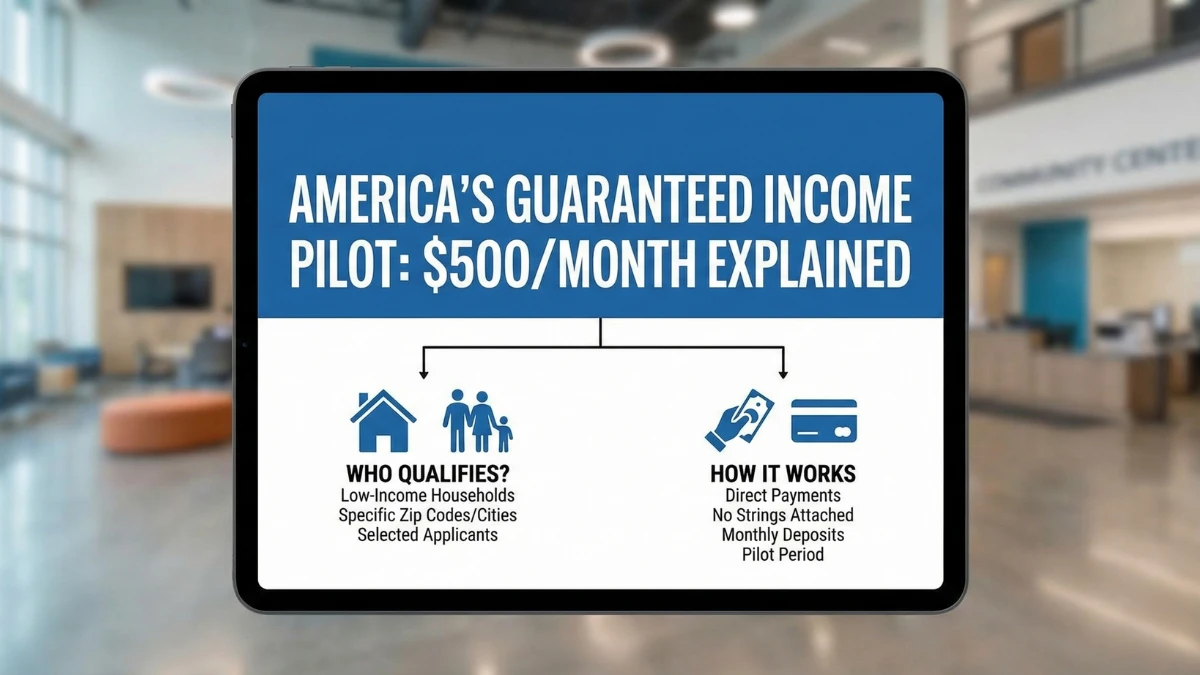
The idea of a $500 monthly guaranteed income program has captured national attention, often described as America’s first major step toward direct cash payments for households. Headlines sometimes suggest a single nationwide program, but the reality is more nuanced. This article explains what guaranteed income actually means in the U.S., who qualifies, how payments are delivered, and what has truly been confirmed by government authorities.
What Is the $500 Monthly Guaranteed Income Program?
The $500 monthly guaranteed income concept refers to a group of local and state pilot programs that provide unconditional cash payments to selected participants for a limited time. These initiatives are often supported through public funding, philanthropy, or federal grants coordinated with the U.S. Department of the Treasury, but they are not a single nationwide program.

| Program Feature | How It Works |
|---|---|
| Monthly Amount | $500 |
| Payment Type | Unconditional cash |
| Program Length | Usually 12–24 months |
| Nationwide for All? | No |
| Automatic Enrollment | No |
Is This a Federal Program for Everyone?
No. Despite viral claims, the $500 guaranteed income initiative is not a universal federal benefit. Programs operate at the city, county, or state level, and participation depends entirely on where you live and whether your local government is running a pilot.
Who Qualifies for the $500 Monthly Payments?
Eligibility rules vary by location but generally focus on low-income households, families with children, seniors, or individuals facing financial instability. Most programs require residency verification, income thresholds, and an application, and many select participants through randomized lotteries.

How Are the $500 Payments Distributed?
Payments are typically issued through direct deposit, prepaid debit cards, or digital payment platforms. These funds are not processed by the IRS as stimulus checks and are usually not tied to tax filing status.
Why This Is Called America’s “First Major” Initiative
The attention comes from the scale and coordination of multiple guaranteed income pilots running at the same time across the country. While no single program covers everyone, the combined reach represents the largest guaranteed income experiment in U.S. history so far.

Is the $500 Payment Permanent?
No. Most guaranteed income programs are temporary pilots designed to study impacts on employment, health, housing stability, and financial stress. Continuation or expansion depends on funding availability, political support, and research results.
Key Facts to Know
- $500 payments are monthly, not one-time
- Programs are local, not nationwide
- Eligibility depends on income and residency
- Applications or lotteries are common
- Payments are not issued by the IRS
Conclusion
The $500 monthly guaranteed income program marks a significant shift in how financial assistance is tested in the United States, but it is not a universal federal payment. Eligibility depends on location and income, and most programs are temporary pilots rather than permanent benefits. Understanding these limits helps set realistic expectations as guaranteed income experiments continue to expand.

Disclaimer
This article is for informational purposes only and does not constitute financial or legal advice. Guaranteed income programs vary by location and may change. Always verify details through official local or government sources.
